Friday, May 16, 2014

#67 In Love


First, let me apologize for my last post. These are the things I believe, but after reading it aloud, it is clear I entertained the argument without disclosing the spirit of the matter. I do not want to alienate my Arminian brothers, for that is the tradition from which I came. In the spirit of the matter, I am imploring not just the reader but myself to test what we believe against that of Holy scripture. Where my heart can so easily deceive me, the scripture itself cannot lie. It is not for God's word to conform to my opinion but rather for me to take the whole counsel of God and conform to the mind of Christ. 

And I brethren when I came to you, did not come with excellence of speech or of wisdom declaring to you the testimony of God. For I determined not to know anything among you except Jesus Christ and Him crucified. I was with you in weakness, in fear, and in much trembling. And my speech and my preaching were not with persuasive words of human wisdom, but in demonstration of the Spirit and of power, that your faith should not be in the wisdom of men but in the power of God. 1Corinthians2: 1-5 NKJV

I am a Christian. I believe that I was a sinner, as was pointed out to me by Holy Scripture. 

Now we know that whatever the law says, it says to those who are under the law, that every mouth may be stopped, and all the world may become guilty before God. Therefore by the deeds of the law no flesh will be justified in His sight, for by the law is the knowledge of sin. But now the righteousness of God apart from the law is revealed, being witnessed by the Law and the Prophets, even the righteousness of God, through faith in Jesus Christ, to all and on all who believe. For there is no difference; for all have sinned and fall short of the glory of God, being justified freely by His grace through the redemption that is in Christ Jesus, whom God set forth as a propitiation by His blood, through faith, to demonstrate His righteousness, because in His forbearance God has passed over the sins that were previously committed, to demonstrate at the present time His righteousness, that He might be just and the justifier of the one who has faith in Jesus. Romans 3:19 - 26 NKJV

And so the law was my teacher, revealing to me the righteousness of God, and the inadequacy of my own righteousness. The law was not weak in it's declaration, but pointed to my inherent inability to attain righteousness. It pointed me to Christ. 

Where is boasting then? It is excluded. By what law? Of works? No, but by the law of faith. Therefore we conclude that a man is justified by faith apart from the deeds of the law. Or is He the God of the Jews only? Is He not also the God of the Gentiles? Yes, of the Gentiles also, since there is one God who will justify the circumcised by faith and the uncircumcised through faith. Do we then make void the law through faith? Certainly not! On the contrary, we establish law. Romans 3:27-31 NKJV

In the old testament, our sin was revealed along with our inability to stand before a righteous judge. Only the priest could enter the house of the Lord. 

All the people shall be in the courts of the house of the Lord. But let no one come into the house of the Lord except the priests and those of the Levites who serve. They may go in, for they are holy; but all the people shall keep the watch of the Lord. 2 Chronicles 23: 5b - 6 NKJV

This painted the picture of One who would enter for many on their behalf, and pay the price of all, so that all who believe could enter through Him.

And according to the law almost all things are purified with blood, and without shedding of blood there is no remission. Therefore it was necessary that the copies of the things in the heavens should be purified with these, but the heavenly things themselves with better sacrifices than these. For Christ has not entered the holy places made with hands, which are copies of the true, but into heaven itself, now to appear in the presence of God for us; not that He should offer Himself often, as the high priest enters the Most Holy Place every year with blood of another- He then would have had to suffer often since the foundation of the world; but now, once at the end of the ages, He has appeared to put away sin by the sacrifice of Himself. And as it is appointed for men to die once, but after this the judgment, so Christ was offered once to bear the sins of many. To those who eagerly wait for Him He will appear a second time, apart from sin, for salvation. Hebrews 9: 22-28 NKJV

We have a new High Priest who sits at the right hand of God and we have become part of the body of Christ and priest unto God.

"You are worthy to take the scroll, and to open its seals; for you were slain, and have redeemed us to God by Your blood Out of every tribe and tongue and people and nation, and have made us kings and priests to our God; and we shall reign on the earth." Revelation 5: 9&10 NKJV

We are to share the gospel.

And how shall they preach unless they are sent? As it is written: "How beautiful are the feet of those who preach the gospel of peace, who bring glad tidings of good things!" But they have not all obeyed the gospel. For Isaiah says, "Lord, who has believed our report?" So then faith comes by hearing, and hearing by the word of God. Romans 10: 15 -17 NKJV

As for doctrine, I believe it should be grounded in Holy Scripture. As to Sola Scriptura it does not denounce tradition, the organization of church or the wisdom to be gained from those who God has called as teachers and ministers. Solo Scriptura, of the anabaptist movement, denies the community of believers and is the believer and the Bible alone; Sola vs. Solo. That would defy Hebrews 10:25.

The Bible does not use the words Sola Scriptura for those that would argue the superiority of tradition. 
As my Muslim, Jehovah Witness, and Mormon friends often point out, the Bible does not use the word Trinity either, as they prefer to denounce the Deity of Christ. 

That's why I always ask, "do you believe the Bible is God's word?"

What led the early reformers to the doctrine of Sola Scriptura? God's word tells us that:

Faith cometh by hearing and hearing by the word of God.

All Scripture is given by inspiration of God, and is profitable for doctrine, for reproof, for correction, for instruction in righteousness, that the man of God may be complete, thoroughly equipped for every good work. 2 Timothy 3:16&17 NKJV

As for the traditions of the early church:

St. Irenaeus of Lyons (+ca.195):
We have learned from none others the plan of our salvation, than from those through whom the gospel has come down to us, which they did at one time proclaim in public, and, at a later period, by the will of God, handed down to us in the Scriptures, to be the ground and pillar of our faith.

(Against Heresies, 3:1.1, in The Ante-Nicene Fathers, Vol. I, p. 414.)


St. Athanasius (c.296-373):
The holy and inspired Scriptures are fully sufficient for the proclamation of the truth.

(Against the Heathen, I:3, quoted in Carl A. Volz, Faith and Practice in the Early Church [Minneapolis: Augsburg Publishing House, 1983], p. 147.)


St. Augustine of Hippo (354-430):
Let them show their church if they can, not by the speeches and mumblings of the Africans, not by the councils of their bishops, not by the writings of any of their champions, not by fraudulent signs and wonders, because we have been prepared and made cautious also against these things by the Word of the Lord; but [let them show their church] by a command of the Law, by the predictions of the prophets, by songs from the Psalms, by the words of the Shepherd Himself, by the preaching and labors of the evangelists; that is, by all the canonical authorities of the sacred books.

(On the Unity of the Church, 16, quoted in Martin Chemnitz, Examination of the Council of Trent, Part I [Saint Louis: Concordia Publishing House, 1971], p. 159.)


St. John Chrysostom:
Regarding the things I say, I should supply even the proofs, so I will not seem to rely on my own opinions, but rather, prove them with Scripture, so that the matter will remain certain and steadfast.

(Homily 8 On Repentance and the Church, in The Fathers of the Church, Vol. 96, p. 118.)


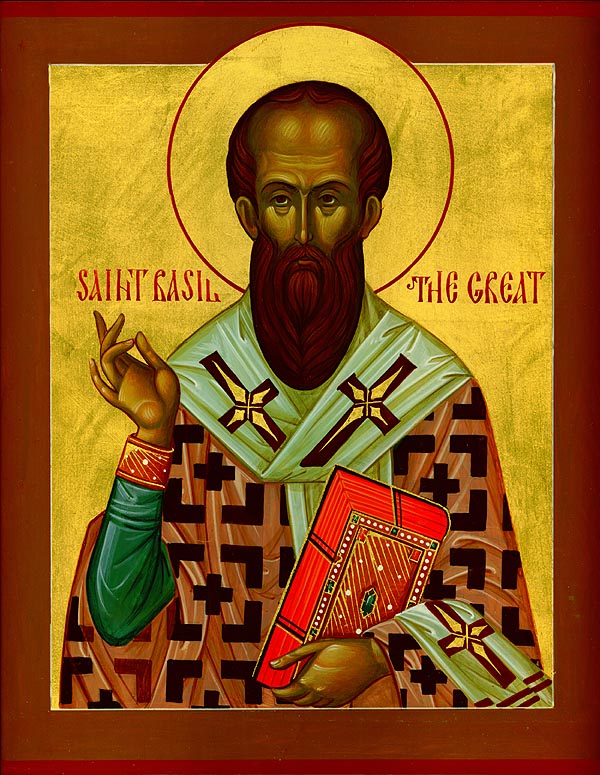
St. Basil the Great:
What is the mark of a faithful soul? To be in these dispositions of full acceptance on the authority of the words of Scripture, not venturing to reject anything nor making additions. For, if “all that is not of faith is sin” as the Apostle says, and “faith cometh by hearing and hearing by the Word of God,” everything outside Holy Scripture, not being of faith, is sin.

(The Morals, in The Fathers of the Church, Vol. 9, p. 204.)

St. Basil the Great:
We are not content simply because this is the tradition of the Fathers. What is important is that the Fathers followed the meaning of the Scripture.

(On the Holy Spirit, 7:16.)

St. John of Damascus (c.675-c.749):
It is impossible either to say or fully to understand anything about God beyond what has been divinely proclaimed to us, whether told or revealed, by the sacred declarations of the Old and New Testaments.

(On the Orthodox Faith, I:2, in The Fathers of the Church, Vol. 37.)

Again, I am a Christian, and I believe that Salvation is of the Lord. People will call me a Calvinist because I take views similar to His in regards to doctrine, but John Calvin is a man, and I follow Christ. 

For when one says, "I am of Paul," and another, "I am of Apollos," are you not carnal? Who then is Paul, and who is Apollos, but ministers through whom you believed, as the Lord gave to each one? I planted, Apollos watered, but God gave the increase. 1Corinthians 3:4-6 NKJV

I hope this answers some of the emails and G+ issues brought up as to what I believe. I hope you read it, in the light that it comes from, which is my love of God's word and you as my friends. 

Thank you, Calvin


Thursday, May 15, 2014

#66 Summation of Genesis 25 Study Part 2


I am speaking the truth in Christ - I am not lying; my conscience bears me witness in the Holy Spirit - that I have great sorrow and unceasing anguish in my heart. For I could wish that I myself were accursed and cut off from Christ for the sake of my brothers, my kinsmen according to the flesh. They are Israelites, and to them belong the adoption, the glory, the covenants, the giving of the law, the worship, and the promises. To them belong the patriarchs, and from their race, according to the flesh, is the Christ who is God over all, blessed forever. Amen. But it is not as though the word of God has failed. For not all who are descended from Israel belong to Israel, and not all are children of Abraham because they are his offspring, but "through Isaac your offspring be named." This means that it is not the children of the flesh who are the children of God, but the children of promise are counted as offspring. for this is what the promise said: "About this time next year I will return and Sarah shall have a son." And not only so, but also when Rebecca had conceived children by one man, our forefather Isaac, though they were not yet born and had done nothing either good or bad - in order that God's purpose of election might continue, not because of works but because of His call - she was told, "the older will serve the younger." As it is written, "Jacob I loved, but Esau I hated." What shall we say then? Is there injustice on God's part? By no means! For he says to Moses, "I will have mercy on whom I have mercy, and I will have compassion on whom I have compassion." So then it depends not on human will or exertion, but on God, who has mercy. For the Scripture says to Pharaoh, "for this very purpose I have raised you up, that I might show my power in you, and that my name might be proclaimed by in all the earth." So then he has mercy on whomever he wills, and he hardens whomever he wills. You will say to me then, "why does He still find fault? For who can resist His will? But who are you, O man, to answer back to God? Will what is molded say to its molder, "why have you made me like this? Has the potter no right over the clay, to make out of the same lump one vessel for honored use and another for dishonorable use? What if God, desiring to show his wrath and to make known his power, has endured with much patience vessels of wrath prepared for destruction, in order to make known the riches of his glory for vessels of mercy, which he has prepared beforehand for glory - even us whom he has called, not from the Jews only but also from the Gentiles? As indeed he says in Hosea, "those who were not my people I will call 'my people,' and her who was not beloved I will call beloved. And in the very place where it was said to them, 'you are not my people, there they will be called 'sons of the living God" and Isaiah cries out concerning Israel: "Though the number of the sons of Israel be as the sand of the sea, for the Lord will carry out his sentence upon the earth fully and without delay." And as Isaiah predicted, "if the Lord of hosts had not left us offspring, we would have been like Sodom and become like Gomorrah." What shall we say, then? That gentiles who did not pursue righteousness have attained it, that is, a righteousness that is by faith; but that Israel who pursued a law that would lead to righteousness did not succeed in reaching that law. Why? Because they did not pursue it by faith, but as if it were based on works. They have stumbled over the stumbling stone, as it is written, "behold I am laying in Zion a stone of stumbling, and a rock of offenses; and whoever believes in Him will not be put to shame." Romans 9 ESV

Paul, in speaking of Israel, is overwhelmed with compassion and love for his Jewish brothers, so much that he would wish that which he cannot perform. He would that he could be lost for the sake of them to be found. It was they, who according to God's Sovereign choice, were adopted to receive the oracles of God and through them God brought up, according to the flesh, Christ. And not just any Messiah, but Christ who is God overall, again pronouncing His deity. 

They had received the word of God, the prophecies of Messiah, the law that they could not keep but should convict the heart, they had the covenants, and the stories of the patriarchs. They had all these things which pointed to a God who does not choose by merit where there is none. So did the word of God fail?

"For as the rain comes down, and the snow from heaven, and do not return there, but water the earth, and make it bring forth and bud, that it may give seed to the sower and bread to the eater, so shall My word be that goes from My mouth; it shall not return to Me void, but it shall accomplish what I please, and it shall prosper in the thing for which I sent it." Isaiah 55: 10&11 NKJV

It did not fail, it accomplished God's will, as Paul points out not all who are descended from Israel belong to Israel, but "through Isaac your offspring be named." Before Jacob and Esau were ever born, outside of tradition, God chose that the older would serve the younger before either had done good or bad. I use to believe that God's foreknowledge implied him seeing the actions of Jacob verses Esau despising His birthright. But here, the writer states it is not based on good or bad. If it were based on merit it could not be by faith. Paul goes even further to state that it was that God's purpose of election might continue, not because of works but because of His call. As a young man I asked and it was explained to me that it was of faith, but the faith of those who believe, and that it was not based upon a work but on God's foreknowledge of those who would believe. It was also explained that Jesus would never interfere with my free will, but rather woo or convince me until I chose Him, based again on already knowing that I would. I accepted this in my early years as a boy in a Southern Baptist church,  a non denominational church, and later as a young man in the Pentecostal movement. I grew to despise men like John Calvin, John MacArthur, and was admittedly shocked to find that such a kind and loving soul, like I found in Charles Spurgeon, could ever believe such a thing as reformed theology. Nevertheless, when I needed a good commentary, I would always find myself reaching for one of MacArthur's. I respected his reverence for the word of God and though I prayed at Ligoneers one year that he would brake out in tongues, it was my own that ceased. But that is another story. It was there that I started to have the desire to know God's word as he intended and not based upon my wants or emotions. This led to more questions:

First, if it was based upon choosing God from my own "free will", then why did the apostle Paul say it was not based on human will or exertion?
The view I was being taught required the exertion of my will to except or allow God's work to take place. When I asked, it was explained to me that we believe this because it is an Arminian view and consistent with Scripture. That is really not true on both accounts.
  1. Arminius, passed away before providing a work on his view, so his followers or Remonstrants wrote the 5 Articles of Remonstrance, which states, Salvation (and condemnation on the day of judgment) was conditioned by the graciously enabled faith (or unbelief) of man;
So what my "Arminian" friend was describing to me was not classical Arminiamism, but rather more in the way of Semi-Pelagianism, which teaches that the beginning of faith is an act of the free will. I have a hard time finding the distinction between this and Pelagianism, where man effects his own salvation. One blatantly claims works at its core while the other tries to deny such claim by way of cooperation. It requires an act of the will which is based in the faith of the one believing, independent of grace, and then later increased by God.  This was like me saying I use to be a humanist but now I am a semi-humanist.
For by grace you have been saved through faith, and that not of yourselves; it is the gift of God, not of works, lest anyone should boast. Ephesians 2: 8&9 NKJV

If I read the words above, not as one trained in the Greek, but within the context of this passage on salvation, it would appear that faith is the antecedent to that or in some translations, this. Being an Arminian, but not exactly sure what that meant, I decided at the time, with some help from someone familiar with Greek, to approach it by way of the phrase, rendering grace through faith as the antecedent, and thus salvation being the gift of God. This approach based upon the gender of the pronoun, this. Salvation is the gift of God, but the statement brakes it down to the level of its components preceding the pronoun. As John MacArthur so straightly and simply puts it: " 'That' refers to the entire previous statement of salvation, not only of grace but the faith. Although men are required to believe for salvation, even that faith is part of the gift of God which saves and cannot be exercised by one's own power. God's grace is preeminent in every aspect of salvation." The interpretation by phrase and or rule of pronoun gender did not help my Arminian stand.

Another point made, in an Arminian argument I saw against this interpretation, was that the word for gift here, was also used as the word for offering in the Greek, but as coming from man to God. I am really trying not to be sarcastic here, but plug that into the verse: you see it follows grace and faith and that not of yourselves, it is the offering from man to God of God, not of works, lest anyone should boast. I'm not seeing how that changes anything. What was the sacrifice for your sins? If you answer, Jesus, then who is Jesus? If you answer God, then Who's offering was found acceptable?

   2. What is the reason, when I was an Arminian, that I should reject J. MacArthur's above interpretation of these verses?

"The Arminian holds that Christ, when He died, did not die with an intent to save any particular person. And they teach that Christ’s death does not in itself secure beyond doubt the salvation of any one man living. They believe that Christ died to make the salvation of all men possible; and that by the doing of something else, any man who pleases may attain unto eternal life. Consequently, they are obliged to hold that if man’s will would not give way and voluntarily surrender to grace, then Christ’s atonement would be unavailing. They hold that there was no secure particularity and specialty in the death of Christ. Christ died, according to them, as much for Judas in hell as for Peter who mounted to heaven. They believe that for those who were consigned to eternal fire, there was as true and real a redemption made as for those who now stand before the throne of the Most High."
Charles Spurgeon

I had not seen this in some time and you can imagine my shock as a young Arminian, reading further in to the works of Spurgeon and finding "Why I am a Calvinist." I respected the man's love of God enough to listen, but thought I had maybe cornered him in the way of 2Peter 3:9:
The Lord is not slack concerning His promise, as some count slackness, but is long-suffering toward us, not willing that any should perish but that all should come to repentance. NKJV


This along with 1Timothy 2:4 were the bullets that I could fire back at the likes of John Calvin, Charles Spurgeon, and John MacArthur. Around the same time I was loading these into their respective chambers, I ran into an old friend from the Pentecostal movement, he had found something even more profound in these verses. It was a special sort of knowledge, an epiphany he called it. He said, "I read it over and over again. No one goes to hell, He is not willing that any should perish, and from 1Tim., He desires all men to be saved." I contested that he was taking this out of context, in a passage talking just  prior, of the judgment of ungodly men, and in 1 Timothy where Paul, not only names two false prophets, but declares that they have been delivered to Satan that they may learn not to blaspheme. He was leaving the whole counsel of God, for an emotional interpretation of scripture, but I wondered, could I somehow be doing the same?

Paul starts this whole message of Romans 9 with an emotional decree, declaring his sorrow and the unceasing anguish of his heart, the will of compassion, not wanting his brothers to be punished. Paul states, "I could wish". He does not here change the message  to match his sorrow though but rather presses on to give the doctrine of election. Can God also not wish that any should perish, but have already judged sin, and by grace save those, whom He has chosen of His active will and pleasure? The Bible never considers it a dichotomy to put together both God's truth and God's love or God's love and God's justice. Is it here any different when we speak of God's will in love, not wanting that any should perish, but allowing in His will that justice be done? And yet again, I will have mercy upon whom I will have mercy. Can we declare God unjust in this? Being that not only did He choose His elect outside of both good deed and good will, He also does not ignore justice in this, but rather pays the price in His Son. It pleased the Lord. I will leave this and move on to the next major question I had as young believer. The next post will continue with questions that came from reading in Genesis of Sodom, and then later in Romans of God's will and election. I will also leave you with an excerpt from Pastor Samson on 2Peter, good stuff:

Without doubt, 2 Peter 3:9 is the single most popular verse used to dismiss the reformed doctrine of election, bar none. Usually the meaning of the verse is assumed without taking any time to study it, which is the very hallmark of tradition. In fact, traditions are so strong that many do not even see the need to study the verse because they believe there is no need to do so. I have to admit that I did this for many years. Those most enslaved to their traditions are those who believe they do not have any. First of all then, let us read the verse in its context.

2 Peter 3:1-9 - This is now the second letter that I am writing to you, beloved. In both of them I am stirring up your sincere mind by way of reminder, that you should remember the predictions of the holy prophets and the commandment of the Lord and Savior through your apostles, knowing this first of all, that scoffers will come in the last days with scoffing, following their own sinful desires. They will say, "Where is the promise of his coming? For ever since the fathers fell asleep, all things are continuing as they were from the beginning of creation." For they deliberately overlook this fact, that the heavens existed long ago, and the earth was formed out of water and through water by the word of God, and that by means of these the world that then existed was deluged with water and perished. But by the same word the heavens and earth that now exist are stored up for fire, being kept until the day of judgment and destruction of the ungodly. But do not overlook this one fact, beloved, that with the Lord one day is as a thousand years, and a thousand years as one day. The Lord is not slow to fulfill his promise as some count slowness, but is patient toward you, not wishing that any should perish, but that all should reach repentance.


The first thing we notice is that the subject of the passage is not salvation but the second coming of Christ. Peter is explaining the reason for the delay in Christ’s second coming – He is still coming, and will come unexpectedly, like a thief in the night (v. 10).

The second thing to notice is the clear identity of the people he is addressing. He speaks of the mockers as â€Å“they”, but everywhere else he speaks to his audience as â€Å“you” and the â€Å“beloved.” This is very important because the assumption that is usually made is that the â€Å“you” the â€Å“any” and the â€Å“all” of 2 Peter 3:9 refers to everyone on the planet.

But surely "all" means â€Å“all,” right? Well usually, yes, but not always. This has to be determined by the context in which the words are found. For example, when a teacher is getting ready to start a class and asks his students, "Are all here?" he is not asking if every last living person on planet earth is present in the room. Rather he is referring to all the students enrolled in the class. It is context that provides the basis for a sound interpretation.

So, the question in 2 Peter 3:9 is whether "all" refers to all human beings without distinction, or whether it refers to everyone within a certain group. The context indicates that Peter is writing to a specific group and not to all of mankind – â€Å“to those who have obtained a faith of equal standing with ours” 2 Peter 1:1. The audience is confirmed when Peter writes, â€Å“This is now the second letter that I am writing to you, beloved.” (2 Peter 3:1)

Can we be even more specific? Yes, because if this is the second letter addressed to them, the first makes it clear who he is writing to. 1 Peter 1:1 - â€Å“Peter, an apostle of Jesus Christ, To those who are elect…” So Peter is writing to the elect in 2 Peter 3, saying:

â€Å“This is now the second letter that I am writing to you, beloved.... But do not overlook this one fact, beloved, that with the Lord one day is as a thousand years, and a thousand years as one day. The Lord is not slow to fulfill his promise as some count slowness, but is patient toward you, not wishing that any should perish, but that all should reach repentance.” (v. 1, 8, 9 - emphasis mine)

If the "any" or â€Å“all” here refers to everyone in human history, the verse would prove far more than Arminians would want to prove - it would prove universalism rather than Christianity. (Universalism is the false doctrine that teaches that everyone will ultimately be saved, with no one going to hell). If God is not willing that any person perish, then what? No one would ever perish! Yet, in context, the "any" that God wills not to perish must be limited to the same group he is writing to, the elect, and the "all" that are to come to repentance is the very same group. Christ’s second coming has been delayed so that all the elect can be gathered in. God is not willing that any of the elect should perish, but that all of them come to repentance.

Rather than denying election, understood in its biblical context, it is one of the strongest verses in favor of it.


Monday, May 12, 2014

#65 Summation of Genesis 25 Study Part 1


Once when Jacob was cooking stew, Esau came in from the field, and he was exhausted. And Esau said to Jacob, "let me eat some of that red stew, for I am exhausted!" (Therefore his name was called Edom.) Jacob said, "sell me your birthright now." Esau said, "I am about to die; of what use is a birthright to me?" Jacob said, "swear to me now." So he swore to him and sold his birthright to Jacob. Then Jacob gave Esau bread and lentil stew, and he ate and drank and rose and went his way. Thus Esau despised his birthright. Genesis 25: 29-34 ESV

An interesting scene, Esau is being more than a little dramatic, as the Scriptures would indicate. He is hardly dying, he is tired and hungry, and is willing to trade his birthright for the desires of his appetite. He is described here as despising his birthright, and used later by the writer of Hebrews as an example of those who grow weary of the sanctifying work of God. The Abrahamic covenant carried with it two branches, that of the material (the sands on the seashore), but most significantly that of the spiritual (as the stars in the heavens). It is God who is Sovereign over both, and the spiritual blessing is eternal, far out weighing real-estate or other temporal possessions.

Pursue peace with all people, and holiness, without which no one will see the Lord: looking carefully lest anyone fall short of the grace of God; lest any root of bitterness springing up cause trouble, and by this many become defiled; lest there be any fornicator or profane person like Esau, who for one morsel of food sold his birthright. For you know that afterward, when he wanted to inherit the blessing, he was rejected, for he found no place for repentance, though he sought it diligently with tears. Hebrews 12-17NKJV

In the same manner that Esau despised his birthright do we not also take lightly the cross? Though we are no longer under the law is it the work of grace that we should live unto the flesh? Should we profane the word of God by teaching that which is more appealing to our life style, or those of our friends who might take offense at some of God's word? Is that  responsible apologetics, consistent with the doctrines set forth in the Bible? How will those who know us by the name we call ourselves, Christian, ever want to hear us speak of sin or the need of a Savior when we do not come bearing the truth in peace? Where are the pears telling me this is not an apple tree? It is a sad thing to see men, who do not claim Jesus as Lord, live humanist lives much more morally compelling than our own. As a young man not wanting the things of God, I clung to the words of David Hume, Socrates and Gandhi.  In David I did not find a moral teacher and in the end, though an intelligent philosopher, his circular reasoning fell apart. But I still took solace in the moral logic of Gandhi, and his words echoed my own problems with the church: "I like your Christ, but I do not like your Christians. They are so unlike your Christ,' or as some others have stated that he most likely put it, 'Oh, I don't reject Christ, I love Christ; its just that so many of you Christians are so unlike your Christ." That was all the confirmation I needed ,at least at the time. It reinforced my issue with the hypocrisy of those in church, but it did not resolve the issue of the hypocrite I couldn't see. Even at first light, when I came to suspect his existence, I decided to confront him myself, in the flesh. I did not take to knee, but rather tried to find hope in the religious, and in my own works. And yet it is still not a call to the holiness of the law which was insufficient, but rather a call back to your first Love. So lightly I held this thing, it was more like a necklace with a cross hanging on it or a tattoo of Calvary. I read where Paul cried out, "O wretched man that I am!" And now why was Paul calling himself wretched? This is disturbing for me because if I compare my life to his, my words to his, my walk with God to his, how is he after everything he has been through, wretched? Unlike me, Paul was not comparing his holiness to Gandhi, to himself to aim higher, or finding someone more wretched, like me, to be content with how far he has come. He is not sinning more, but rather comparing his holiness to God's, and exposing his every weakness. He does not crucify Christ anew nor despise the cross, but rather despises his sin.

For by one offering He has perfected forever those who are being sanctified. But the Holy Spirit also witnesses to us; for after He had said before, "this is the covenant that I will make with them after those days, says the Lord: I will put My laws into their hearts, and in their minds I will write them," then He adds, "their sins and their lawless deeds I will remember no more." Now where there is remission of these, there is no longer an offering for sin. Hebrews 10:14-18 NKJV

"There is only one way to have assurance of salvation: that is, to realize we are condemned, and be satisfied that the blood of the Lord Jesus Christ alone can wash us and cleanse us." - John Calvin

"The adoption of Jacob was founded on the sole good pleasure of God...lest men should attribute something to their own preparatory acts." John Calvin


Sunday, May 11, 2014

#64 Jacob and Esau Genesis 25


These are the generations of Ishmael, Abraham's son, whom Hagar the Egyptian, Sarah's servant, bore to Abraham. These are the names of the sons of Ishmael, named in the order of their birth: Nebaioth, the firstborn of Ishmael; and Kedar, Adbeel, Mibsam, Mishma, Dumah, Massa, Hadad, Tema, Jetur, Naphish, and Kedemah. These are the sons of Ishmael and these are their names, by their villages and by their encampments, twelve princes according to their tribes. (These are the years of the life of Ishmael: 137 years. He breathed his last and died, and was gathered to his people.) they settled from Havilah to Shur, which is opposite Egypt in the direction of Assyria. He settled over against all his kinsmen. These are the generations of Isaac, Abraham's son: Abraham fathered Isaac, and Isaac was forty years old when he took Rebekah to be his wife, the daughter of Bethuel the Aramean of Paddan-aram, the sister of Laban the Aramean. And Isaac prayed to the Lord for his wife, because she was barren. And the Lord granted his prayer, and Rebekah his wife conceived. The children struggled together within her, and she said, "if it is thus, why is this happening to me?" So she went to inquire of the Lord. And the Lord said to her, "two nations are in your womb, and two peoples from within you shall be divided; the one shall be stronger than the other, the older shall serve the younger." When her days to give birth were completed, behold, there were twins in her womb. The first came out red, all his body like a hairy cloak, so they called his name Esau, Afterward his brother came out with his hand holding Esau's heel, so his name was called Jacob. Isaac was sixty years old when she bore them. When the boys grew up, Esau was a skillful hunter, a man of the field, while Jacob was a quiet man, dwelling in tents. Isaac loved Esau because he ate of his game, but Rebekah loved Jacob. Genesis 25: 12-28 ESV

By custom and tradition, the elder would receive the birth right, but God has made it clear to Rebekah that this is not His choice. Esau's children will not carry the blood line for the continuation of the covenant He made with Abraham. God has chosen, outside and above man's tradition, to keep His covenant with the younger, Jacob. Isaac has chosen Esau, he relates to the eldest and enjoys the game he brings home. He is a man's man, a hunter and he is the oldest. God has chosen Jacob, he is a mama's boy and later a calculating deceiver. He is the favorite of his mother, and she probably feels justified in this since God has said that the older shall serve the younger. There was never a need for favoritism, but only trust in God's will. Man's intervention will in no way thwart God's plan nor will it ever be a necessity to His work, but the choices we make with our children can have long lasting ramifications. Here, it works to be divisive, between not only brothers but also between husband and wife.

There is a Messianic theme in here along with the doctrines of grace that Paul will later reference in his defense of election. Before we dive so deep, I would like to touch on some other points often overlooked in favor of the debate. There is in this the matter of preference both in respect of person, and in the handling of God's word.

Abraham was given God's covenant and told that Sarah would have a son, but in view of the natural he opted for plan B, and had a son by his wife's handmade. God's plan had not changed and he did not ask for this intervention, and when they speak again, Abraham, who loves Ishmael and has grown attached to him, tries to slip him in to the conversation as the heir. This does not change God's mind, and God does not settle for less than what He sets out to do. It is in doubt because he is old and his wife is passed the time of children. It is also an easy way out. I have done this outside of Your will, now if You could just change Your will, and make Ishmael the heir, we could just sweep the whole thing under the rug and no hard feelings. I have spent much time there and the wounds, they do run deep.

So it was, when they came, that he looked at Eliab and said, "surely the Lord's anointed is before Him!" But the Lord said to Samuel, "do not look at his appearance or at his physical stature, because I have refused him. For the Lord does not see as a man sees; for man looks at the outward appearance, but the Lord looks at the heart." 1Samuel 16: 6&7 NKJV

For He shall grow up before Him as a tender plant, And as a root out of dry ground. He has no form nor comeliness; And when wee see Him, there is no beauty that we should desire Him. Isaiah 53:2 NKJV

Quite honestly, I would have chosen Esau too. I like to hunt and fish, and he represented the manly ideal that would have been a natural choice later for a robust and strong Messiah. While Jacob does not represent Jesus in character, he shares in the representation of God's will and the glory of His volition. Jesus came as a servant, washing people's feet, and not seeking the acceptance of the religious rulers. He came to seek and to save the lost, and not bearing a sword, he instead commends a Roman centurion of his faith. He is not the preferred Messiah then or now, and it is only through faith that men come to see, that He is the only choice and the rightful heir to share in God's glory. The Jews wanted a Messiah that would destroy Rome, they did want a Messiah to point out their sin nor a lamb to fulfill the word of God that had been spoken and revealed since the beginning of time. It is the same today; we want miracle Jesus, we want to share in the power of God, we want closure from the world and it's suffering, but we do not want to wash feet or forgive. We love debate, and though we should not shrink from defending the gospel, we should do so in love.

The world still seeks it's own Messiah and we are told that he will come promising peace and instead bring destruction. Many false Messiah's have come, and they preach to men's pride. They are politicians, they are personalities, television stars, and those who try to appeal to the whims of man rather than the will of God. Men blame God for their disbelief, or some say that God does not exist, and that the Bible is not the inspired by God. They claim to seek truth, but I contest, for all I see is men seeking to prove true that which they already believe. They sacrifice the truth to turn to their own way.


Saturday, May 10, 2014

#63 Burying Together Genesis 25


Abraham again took a wife, and her name was Keturah. And she bore him Zimran, Jokshan, Medan, Midian, and Ishbak, and Shuah. Jockshan begot Sheba and Dedan. And the sons of Dedan were Asshurim, Letushim, and Leummim. And the sons of Midian were Ephah, Epher, Hanoch, Abidah, and Eldaah. All these were the children of Keturah. And Abraham gave all that he had to Isaac. But Abraham gave gifts to the sons of the concubines which Abraham had; and while he was still living he sent them eastward, away from Isaac his son, to the country of the east. This is the sum of the years of Abraham's life which he lived: one hundred and seventy five years. Then Abraham breathed his last and died in a good old age, an old man and full of years, and was gathered to his people. And his sons Isaac and Ishmael buried him in the cave of Machpelah, which is before Mamre, in the field of Ephron the son of Zohar the Hittite, the field which Abraham purchased from the sons of Heth. There Abraham was buried, and Sarah his wife. And it came to pass, after the death of Abraham, that God blessed his son Isaac. And Isaac dwelt at Beer Lahai Roi. Genesis 25: 1-11 NKJV

It is interesting in verse 9 that both Isaac and Ishmael bury their father Abraham. Abraham has scattered Isaac's half brothers away, and to the East. This is most likely to ensure that there will be no contest for the inheritance. But here we have Isaac and Ishmael, though estranged from each other early on, now returning to pay their respects and bury their father together. 

When Jesus heard it, He marveled, and said to those who followed, "Assuredly, I say to you, I have not found such great faith, not even in Israel! And I say to you that many will come from the east and west, and sit down with Abraham, Isaac, and Jacob in the kingdom of heaven. But the sons of the kingdom will be cast out into outer darkness. There will be weeping and gnashing of teeth." Then Jesus said to the centurion, "go your way; and as you have believed, so let it be done for you." And his servant was healed that same hour. Matthew 8:10-13 NKJV

Here, Jesus defines the kingdom of God and defies the rabbinical teaching of the time. It is not the nation physical, but that of faith, theirs had become a religion based upon birthright. The glorious thing is that the remnant of Israel who do believe, seeing that there is no way by physical means, nor by birth to enter the kingdom of heaven. They, who see that there is only one way by which men can be saved, will in and by trusting Jesus Christ as Savior, be joined to those who were once estranged but have trusted the same. There and only there is true peace found, in that we are all reconciled to God through Christ, and now one body. Many of Ishmael's children will sit down with Isaac's children at the great feast. Even now through Christ I have been able to witness the reconciliation of those who were born enemies. Remember, if you are a Christian, that in God's kingdom the lion will lay down with the lamb, and if you are a Christian then even now your testimony is that of one, who by faith, walks in that kingdom even now. I love you regardless of your phenotype or place of birth, even if you have chosen to be my enemy; it is not for me to hate you. 


Friday, May 9, 2014

#62 Rebekah Leaves Home Genesis 24


Now Rebekah had a brother whose name was Laban, and Laban ran out to the man by the well. So it came to pass, when he saw the nose ring, and the bracelets on his sister's wrists, and when he heard the words of his sister Rebekah, saying "thus the man spoke to me," that he went to the man. And there he stood by the camels at the well. And he said, "come in, O blessed of the Lord! Why do you stand outside? For I have prepared the house, and a place for the camels." Then the man came to the house. And he unloaded the camels, and provided straw and feed for the camels, and water to wash his feet and the feet of the men who were with him. Food was set before him to eat, but he said, "I will not eat until I have told about my errand." And he said, "speak on." So he said, "I am Abraham's servant. The Lord has blessed my master greatly, and he has become great; and He has given him flocks and herds, silver and gold, male and female servants, and camels and donkeys. And Sarah my master's wife bore a son to my master when she was old; and to him he has given all that he has. Now my master made me swear, saying, 'you shall not take a wife for my son from the daughters of the Canaanites, in whose land I dwell; but you shall go to my father's house and to my family, and take a wife for my son.' And I said to my master, 'perhaps the woman will not follow me.' But he said to me, 'the Lord, before whom I walk, will send His angel with you and prosper your way; and you shall take a wife for my son from my family and from my father's house. You will be clear from this oath when you arrive among my family; for if they will not give her to you, then you will be released from my oath.' And this day I came to the well and said, 'O Lord God of my master Abraham, if You will now prosper the way in which I go, behold, I stand by the well of water; and it shall come to pass that when the virgin comes out to draw water, and I say to her, "please give me a little water from your pitcher to drink," and she says to me, "drink, and I will draw for your camels also," - per her be the woman whom the Lord has appointed for my master's son.' "But before I had finished speaking in my heart, there was Rebekah, coming out with her pitcher on her shoulder; and she went down to the well and drew water. And I said to her, 'please let me drink.' and she made haste and let her pitcher down from her shoulder, and said, 'drink, and I will five your camels a drink also.' So I drank, and she gave the camels a drink also.' Then I asked her, and said, 'whose daughter are you?' And she said, 'the daughter of Bethuel, Nahor's son, whom Milcah bore to him.' So I put the nose ring on her nose and the bracelets on her wrists. and I bowed my head and worshiped the Lord, and blessed the Lord God of my master Abraham, who had led me in the way of truth to take the daughter of my master's brother for his son. Now if you will deal kindly and truly with my master, tell me. And if not, tell me, that I may turn to the right hand or to the left." Then Laban and Bethuel answered and said, "the thing comes from the Lord; we cannot speak to you either bad or good. Here is Rebekah before you; take her and go, and let her be your master's son's wife, as the Lord has spoken." And it came to pass, when Abraham's servant heard these words, that he worshipped the Lord, bowing himself to the earth. Then the servant brought out jewelry of silver, jewelry of gold, and clothing, and gave them to Rebekah. He also gave precious things to her brother and to her mother. And he and the men who with him ate and drank and stayed all night. Then they arose in the morning, and he said, "send me away to my master." But her brother and her mother said, "let the young woman stay with us a few days, at least ten; after that she may go." And he said to them, "do not hinder me, since the Lord has prospered my way; send me away so that I may go to my master." So they said, "we will call the young woman and ask her personally." Then they called Rebekah and said to her, "will you go with this man?" And she said, "I will go." So they sent away Rebekah their sister and her nurse, and Abraham's servant and his men. And they blessed Rebekah and said to her: "our sister, may you become the mother of thousands of ten thousands; and may your descendants possess the gates of those who hate them." Then Rebekah and her maids arose, and they rode on the camels and followed the man. So the servant took Rebekah and departed. Now Isaac came from the way of Beer Lahai Roi, for he dwelt in the South. And Isaac wing out to meditate in the field in the evening; and he lifted his eyes and looked, and there, the camels were coming. then Rebekah lifted her eyes, and when she saw Isaac she dismounted from her camel; for she had said to the servant, "who is this man walking in the field to meet us?" The servant said, "it is my master." So she took a veil and covered herself. And the servant told Isaac all the things he had done. Then Isaac brought her into his mother Sarah's tent; and he took Rebekah and she became his wife, and he loved her. So Isaac was comforted after his mother's death.  Genesis 24:29 -67 NKJV

A beautiful story, and how wonderful to be the servant on such an errand. How faithful a friend he was, not only to his master, but also to his master's son. It is a relief and a blessing to know that God goes before us and we have but to trust, pray, obey, and say what he wants us to. The outcome belongs to Him, and ours is the burden which he has made light. The burden of delivering his word, and taking care not to alter it in preference of acceptance. They received it well but then upon reflection wanted to delay in acting upon it. Abraham's servant stayed steadfast to the errand and Rebekah came willingly. 


Thursday, May 8, 2014

#61 Rebekah Genesis 24


Then the servant took ten of his master's camels and departed, taking all sorts of choice gifts from his master; and he arose and went out to Mesopotamia to the city of Nahor. And he made the camels kneel down outside the city by the well of water at the time of evening, the time when women go out to draw water. And he said, "O Lord, God of my master Abraham, please grant me success today and show steadfast love to my master Abraham. Behold, I am standing by the spring of water, and the daughters of the men of the city are coming out to draw water. Let the young woman to whom I shall say, 'please let down your jar that I may drink,' and who shall say, 'drink, and I will water your camels' - let her be the one whom you have appointed for your servant Isaac. By this I shall know that you have shown steadfast love to my master." Before he had finished speaking, behold, Rebekah, who was born to Bethuel the son of Milcah, the wife of Nahor, Abraham's brother, came out with her water jar on her shoulder. The young woman was very attractive in appearance, a maiden who no man had known. She went down to the spring and filled her jar and came up. then the servant ran to meet her and said, "please give me a little water to drink from your jar." She said, "drink, my lord." And she quickly let down her jar upon her hand and gave him a drink. When she had finished giving him a drink, she said, "I will draw water for your camels also, until they have finished drinking." So she quickly emptied her jar into the trough and ran again to the well to draw water, and she drew for all his camels. The man gazed at her in silence to learn whether the Lord had prospered his journey or not. When the camels had finished drinking, the man took a gold ring weighing a half a shekel, and tow bracelets for her arms weighing ten gold shekels, and said, "please tell me whose daughter you are. Is there room in your father's house for us to spend the night?" She said to him, "I am the daughter of Bethuel, the son of Milcah, whom she bore to Nahor." She added, "we have plenty of both straw and fodder, and room to spend the night." The man bowed his head and worshiped the Lord and said, "blessed be the Lord, the God of my master Abraham, who has not forsaken his steadfast love and his faithfulness toward my master. As for me, the Lord has led me in the way to the house of my master's kinsmen." Then the young woman ran and told her mother's household about these things. Genesis 24: 10-28 ESV

Abraham's servant returns to Mesopotamia, the land of Abraham's kin, and there talks to the Lord. He requests a sign to verify that he has found the right girl to be Isaac's wife. He petitions asking God to remember his steadfast love to Abraham. God has been with Abraham so far, please allow his servant to continue in this love on Abraham's behalf. 

He has remembered His steadfast love and faithfulness to the house of Israel. All the ends of the earth have seen the salvation of our God. Psalm 98:3 ESV 

Wednesday, May 7, 2014

#60 Oath Genesis 24


Now Abraham was old, well advanced in age; and the Lord had blessed Abraham in all things. So Abraham said to the oldest servant of his house, who ruled over all that he had, "please put your hand under my thigh, and I will make you swear by the Lord, the God of heaven and the God of the earth, that you will not take a wife for my son form the daughters of the Canaanites, among whom I dwell; but you shall go to my country and to my family, and take a wife for my son Isaac." And the servant said to him, "perhaps the woman will not be willing to follow me to this land. Must I take your son back to the land from which you came?" But Abraham said to him, "beware that you do not take my son back there. The Lord God of heaven, who took me from my father's house and from the land of my family, and who spoke to me and swore to me, saying, 'to your descendants I give this land,' He will send His angel before you, and you shall take a wife for my son from there. And if the woman is not willing to follow you, then you will be released from this oath; only do not take my son back there." So the servant put his hand under the thigh of Abraham his master, and swore to him concerning this matter. Genesis 24: 1-9

As the oldest servant, Eliezer would have been the first in line to inherit Abraham's possessions if he would have had no children. 

Abraham stresses the seriousness of the task he is asking his servant to perform by having him participate in a formal oath. He invokes the name of God, that his servant understand that this between them, before the God of heaven and earth. He has Eliezer put his hand under his thigh which is apparently a gesture signifying that the oath taker understands he is in a covenant and accepts the responsibility to perform what is asked of him. 

The contact has one clause of release, and that is if the girl refuses to return with the servant. Abraham seems confident that this is in God's will as he declares that His angel will go before the servant. 

Tuesday, May 6, 2014

#59 Sarah's Passing Genesis 23


Sarah lived 127 years; these were the years of the life of Sarah. And Sarah died at Kiriath-arba (that is, Hebron) in the land of Canaan, and Abraham went in to mourn for Sarah and to weep for her. And Abraham rose up from before his dead and said to the Hittites, "I am a sojourner and foreigner among you; give me property among you for a burying place, that I may bury my dead out of my sight." The Hittites answered Abraham, "hear us, my lord; you are a prince of God among us. Bury your dead in the choicest of our tombs. None of us will withhold from you his tomb to hinder you from burying your dead." Abraham rose and bowed to the Hittites, the people of the land. and he said to them, "if you are willing that I should bury my dead out of my sight, hear me and entreat for me Ephron the son of Zohar, that he may give me the cave of Machpelah, which he owns; it is at the end of his field. For the full price let him give it to me in your presence as property for a burying place." Now Ephron was sitting amon the Hittites, and Ephron the Hittite answered Abraham in the hearing of the Hittites, of all who went in at the gate of the city, "no, my lord, hear me: I give you the field, and I give you the cave that is in it. In the sight of the sons of my people I give it to you. Bury your dead." Then Abraham bowed down before the people of the land. And he said to Ephron in the hearing of the people of the land, "but if you will, hear me: I give the price of the field. Accept it from me, that I may bury my dead there." Ephron answered Abraham, "my lord, listen to me: a piece of land worth 400 shekels of silver, what is that between you and me? Bury your dead."Abraham listened to Epron, and Abraham weighed out for Ephron the silver that he had named in the hearing of the Hittites, 400 shekels of silver, according to the weights current among the merchants. So the field of Ephron in Machpelah, which was to the east of Mamre, the field with the cave that was in it and all the trees that were in the field, throughout its whole area, was made over to Abraham as a possession in the presence of the Hittites, before all who went in at the gate of the city. after this, Abraham buried Sarah his wife in the cave of the field of Machpelah east of Mamre (that is, Hebron) in the land of Canaan. The field and the cave that is in it were made over to Abraham as property for a burying place. Genesis 23 ESV 

The only woman's age to be mentioned in the Bible is Sarah's. I don't believe the significance to rest in matriarchal status but more so in reflection upon the miracle of the age she was when she gave birth. In chapter 17 vs. 17 Abraham says in his heart, "shall Sarah, who is ninety years old, bear a child?" She lives 37 more years after this and has now passed, leaving a mourning Abraham.

Abraham goes to the local settlers and negotiates for a piece of property owned by a man named Ephron. Ephron offers to give him the land, but Abraham pays for it by weighing out 400 shekels of silver.  This is about 11 grams or less than half an ounce of silver. Since he weighed it out this would appear to be in a time before standardized coin currency, and the shekel then would be based on standardized weights and scales. This was done at the gate of the city before the merchants and other witnesses.

He can now bury his dead.


Monday, May 5, 2014

#58 Believe, Obey Genesis 22


And the angel of the Lord called to Abraham a second time form heaven and said, "By myself I have sworn, declares the Lord, because you have done this and have not withheld your son, your only son, I will surely bless you, and I will surely multiply your offspring as the stars of heaven and as the sand that is on the seashore. And your offspring shall possess the gate of his enemies, and in your offspring shall all nations of the earth be blessed, because you have obeyed my voice." So Abraham returned to his young men, and they arose and went to Beersheba. And Abraham lived at Beersheba. Now after these things it was told to Abraham, "behold, Milcah also has borne children to your brother Nahor: Uz his firstborn, Buz his brother, Kemuel the father of Aram, Chesed, Hazo, Pildash, Jidlaph, and Bethuel." (Bethuel fathered Rebekah.) These eight Milcah bore to Nahor, Abraham's brother. Moreover, his concubine, whose name was Reumah, bore Tebah, Gaham, Tahash, and Maacah. Genesis 22: 15-24 ESV

Here, God reaffirms His covenant with Abraham and states again, "because you have done this thing, and have not withheld your son, your only son." Everything we are and all that we have belong to God. If we truly believe this, that God is real, that He gave His only begotten Son to die in our stead, then our actions will testify to our Faith. As one writer so well puts it:

What does it profit, my brethren, if someone says he has faith but does not have works? Can faith save him? If a brother or sister is naked and destitute of daily food, and one of you says to them, "depart in peace, be warmed and filled," but you do not give them the things which are needed for the body, what does it profit? Thus also faith by itself, if it does not have works, is dead. But someone will say, "you have faith, and I have works." Show me your faith without your works, and I will show you my faith by my works. You believe that there is one God. You do well. Even the demons believe - and tremble! But do you want to know, O foolish man, that faith without works is dead? Was not Abraham our father justified by works when he offered Isaac his son on the altar? Do you see that faith was working together with his works, and by works faith was made perfect? And the Scripture was fulfilled which says, "Abraham believed God, and it was accounted to him for righteousness." And he was called the friend of God. You see then that a man is justified by works, and not by faith only. Likewise, was not Rahab the harlot also justified by works when she received the messengers and sent them out another way? For as the body without the spirit is dead, so faith without works is dead also. James 2: 14-26 NKJV

Faith had already been accounted to Abraham when By faith:

  1. obeyed when he was called to go out to the place which he would receive as an inheritance Hebrews 11:8 NKJV
  2. dwelt in the land of promise as in a foreign country, Heb. 11:9 NKJV
  3. And he believed in the Lord, and He accounted it to him for righteousness. Gen. 15:6 NKJV
When we truly believe, it is evidenced by our walk. Does the man or woman of faith pass his fellow man, leaving him naked and hungry? Does he tell him to "name it and claim it", "be warmed and filled?" We are told that, "faith is the substance of things hoped for and the evidence of things not seen." Abraham left the place he knew, he lived in the place of promise as a stranger, and died not seeing the multitude of descendants God had promised. We often take a warped view of faith. "If you would have believed harder, then your child would not be sick. If you visualize that new car and have faith, not doubting, then you will get that new car." I hear people say things like this and even attempt to relate it to the story of Abraham, but ask yourself: What were the things Abraham hoped for, and where did his hope come from? The substance and confidence of Abraham's hope was in the promises of God. Abraham believed in, hoped for and waited on God's promise. When he doubted, or could not see, he took matters into his own hands, and relied upon his own wisdom. It was in those moments, he deceived others, saying, she is my sister, or even offered God an alternative plan, in one from his house ,or in his son, Ishmael. Faith does not go untested by doubt, but rather and most humbly finds it way back to the cross. Faith believes in the promises of God and ask for help with the unbelief of man. It is tied to a changed heart, one that now has love and the desire to obey God. It's spirit is evidenced by the works of God justifying the believer, and sanctifying him through the work of Christ.


Sunday, May 4, 2014

#57 "Your son, your only son" Genesis 22


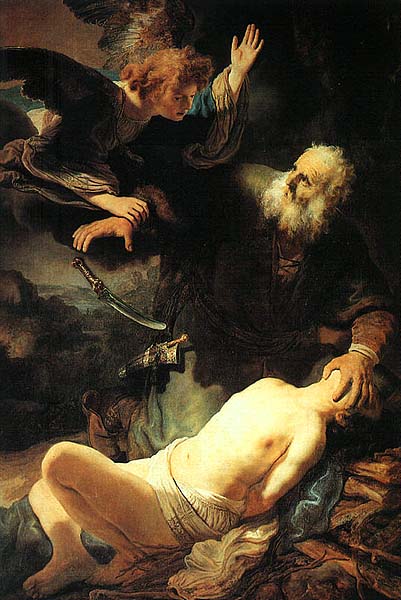
After these things God tested Abraham and said to him, "Abraham!" And he said, "Here am I." He said, "Take your son, your only son Isaac, whom you love, and go to the land of Moriah, and offer him there as a burnt offering on one of the mountains of which I shall tell you." So Abraham rose early in the morning, saddled his donkey, and took two of his young men with him, and his son Isaac. And he cut the wood for the burnt offering and arose and went to the place of which God had told him. On the third day Abraham lifted up his eyes and saw the place from afar. Then Abraham said to his young men, "Stay here with the donkey; I and the boy will go over there and worship and come again to you." And Abraham took the wood of the burnt offering and laid it on Isaac his son. and he took in his hand the fire and the knife. So they went both of them together. And Isaac said to his father Abraham, "My father!" And he said, "Here am I, my son." He said, "behold, the fire and the wood, but where is the lamb for a burnt offering?" Abraham said, "God will provide for Himself the lamb for a burnt offering my son." So they went both of them together. When they came to the place which God had told him, Abraham built the altar there and laid the wood in order and bound Isaac his son and laid him on the altar, on top of the wood. Then Abraham reached out his hand and took the knife to slaughter his son. But the angel of the Lord called to him from heaven and said, "Abraham, Abraham!" And he said, "Here am I." He said, "do not lay your hand on the boy or do anything to him, for now I know that you fear God, seeing you have not withheld your son, your only son, form me." And Abraham lifted up his eyes and looked, and behold, behind him was a ram, caught in a thicket by his horns. And Abraham went and took the ram and offered it up as a burnt offering instead of his son. So Abraham called the name of that place, "The Lord will provide", as it is said to this day, "On the mount of the Lord it shall be provided." Genesis 22: 1-14 ESV

God tested Abraham. I remember reading this as a small boy, and accepting that God was testing Abraham's faith. As a young man, who thought himself to have outgrown God and fables, I thought ,"what kind of warped and twisted God is this?" What could have possibly been going through poor Abraham's mind at this time? It was not long after this that I read again, and the Bible does not leave me  here to my own imagination, no, rather God's word tells me what Abraham thought:

By faith Abraham, when he was tested, offered up Isaac, and he who had received the promises was in the act of offering up his only son, of whom it was said, "through Isaac shall your offspring be named." He considered that God was able even to raise him from the dead, from which, figuratively speaking, he did receive him back. Hebrews 11: 17 - 19 ESV

God tells him to take Isaac to the land of Moriah. Moriah is associated with what would later become Jerusalem, and he is to take his son, his only son, and offer him there as a sacrifice. Abraham obeys without delay, but it will not be till the third day that they arrive. I don't know, but something about this story sounds familiar.

It is too long of a journey not to think. This is the God who made a covenant with me. This is the boy through which He said my seed would be called. I thought my wife could not have this child because her womb was dead. God breathed life where there had been none. I recognized God as the Creator, and knew better what that means. What He says He will do. Has he ever broken His word? When I heard the voice of God, but looked and saw only circumstances, He was still greater. After all of this I have learned to trust not in my own understanding, nor in what I see now, but on the Word that God has spoken to me. He asked so I must do. He promised so I believe.

Abraham is questioned by his son, and he answers that God will provide for Himself the lamb. It reminds me of a song we use to sing when I was little, "Tell me the story of Jesus." God has foretold Messiah's coming all the way back to the fall. He has demonstrated that sin brings death and that the wages of sin is death. The people sacrifice those animals that are approved or called clean. It is here, now, with Abraham's knife wielding hand, raised above his "only son", that we now see the substitutionary atonement introduced. It is the plan of God all along, but here we have the picture. More important then the land, bigger than a nation, beyond the child now laying on the wood, Abraham is stopped by the voice of God, and the substitution is made.


Saturday, May 3, 2014

#56 Place of the Oath Genesis 21


And it came to pass at the time that Abimelech and Phicol, the commander of his army, spoke to Abraham, saying, "God is with you in all that you do. Now therefore, swear to me by God that you will not deal falsely with me, with my offspring, or with my posterity; but that according to the kindness that I have done to you, you will do to me and to the land in which you have dwelt." And Abraham said, "I will swear." Then Abraham rebuked Abimelech because of a well of water which Abimelech's servants had seized. And Abimelech said, "I do not know who has done this thing; you did not tell me, nor had I heard of it until today." So Abraham took sheep and oxen and gave them to Abimelech, and the two of them made a covenant. And abraham set seven ewe lambs of the flock by themselves. Then Abimelech asked Abraham, "What is the meaning of these seven ewe lambs which you have set by themselves?" And he said, "You will take these seven ewe lambs from my hand, that they be my witness that I have dug this well." Therefore he called the place Beersheba, because the two of them swore an oath there. Thus they made a covenant at Beersheba. So Abimelech rose with Phicol, the commander of his army, and they returned to the land of the Philistines. Then Abraham planted a tamarisk tree in Beersheba, and there called on the name of the Lord, the Everlasting God. And Abraham stayed in the land of the Philistines many days. Genesis 21: 22-34 NKJV

Abraham makes an oath with Abimelech, the king of the region, who recognizes that God is with Abraham. Abraham has been silent on an ongoing issue concerning resources. Abimelech's men have seized a well and the king is apparently unaware. Water would be a significant resource to herders and Abraham's silence on the matter is probably to keep peace as a guest on this land. The king has left him an opening in this conversation to which Abraham seizes as opportunity to raise issue. They make a treaty there and name the place, Beersheba, "well of the oath or well of the seven." 

Why the seven? I have been searching this out and found that the Hebrew word for oath comes from the same root as the Hebrew word for seven. Abraham also plants a tree here in the place of this oath, he is settling here and at peace with his neighbor. Abraham has shown patience this time, and instead of creating conflict by asserting himself or demanding justice from a sense of entitlement as God's prophet, he waits on God's timing and receives not only justice but a recognized place in the land. 

Blessed are the meek, for they shall inherit the earth. Matthew 5:5 NKJV

Blessed are the peacemakers, for they shall be called the sons of God. Matthew 5:9 NKJV

As one writer has put it, "Meekness is not weakness, it is power under control."
Christians have the truth in them, they are part of the New Covenant, and waiting upon the return of Christ, but instead of demanding our rights now, He has asked who is the least among you, who can be a servant? Our attitudes and actions are to be no longer shaped by those around us, or by our material resources. We are to forgive as we have been forgiven, and to proclaim the gospel of Christ to His glory and honor, not our own. 


Friday, May 2, 2014

#55 The laughter of Ridicule Genesis 21


So the child grew and was weaned. And Abraham made a great feast on the same day that Isaac was weaned. And Sarah saw the son of Hagar the Egyptian, whom she had borne to Abraham, scoffing. Therefore she said to Abraham, "cast out this bondwoman and her son; for the son of this bond woman shall not be heir with my son, namely with Isaac." And the matter was very displeasing in Abraham's sight because of his son. But God said to Abraham, "do not let it be displeasing in your sight because of   the lad or because of your bondwoman. Whatever Sarah has said to you, listen to her voice; for in Isaac your seed shall be called. Yet I will also make a nation to the son of the bondwoman, because he is your seed." So Abraham rose early in the morning, and took bread and a skin of water; and putting it on her shoulder, he gave it and the boy to Hagar, and sent her away. Then she departed and wandered in the Wilderness of Beersheba. And the water in the skin was used up, and she placed the boy under one of the shrubs. Then she went and sat down across from him at a distance of about a bowshot; for she said to herself, "let me not see the death of the boy." So she sat opposite him, and lifted her voice and wept. and God heard the voice of the lad. Then the angel of God called to Hagar out of heaven, and said to her, "what ails you, Hagar? Fear not, for God has heard the voice of the lad where he is. Arise, lift up the lad and hold him with your hand, for I will make him a great nation." Then God opened her eyes, and she saw a well of water. And she went and filled the skin with water, and gave the lad a drink. So God was with the lad; and he grew and dwelt in the wilderness, and became an archer. He dwelt in the Wilderness of Paran; and his mother took a wife for him from the land of Egypt. Genesis 21: 8-21 NKJV

Ishmael is caught scoffing, or in the Hebrew, the laughter of ridicule, Sarah is offended and demands the removal of Ishmael from the settlement. He is about 17 years old at this time, and Abraham, though close to Ishmael and uncomfortable with Sarah's demand, sends both Hagar and Ishmael away. God speaks to Abraham before this course of action, and settles his reservations. He has promised to make a nation from Ishmael, but like the tower of Babel, it is neither His covenant nor His command, so He is asking Abraham to trust Him with the life of his firstborn. Abraham acts in obedience by faith in God's word, and the angel of the Lord visits Hagar and Ishmael in the wilderness. "In Isaac your seed shall be called," yet, "what ails you Hagar?', and 'lift up the lad and hold him with your hand, for I will make him a great nation."

This is the same visitor from before, the "Messenger of Yahweh", who reveals Himself as God both to Abraham, in the earlier passages preceding the destruction of Sodom, and later to Moses within the context of Exodus 3. The angel appears to Moses in a flaming bush and then is identified by the writer as Lord, followed by a quote from the messenger in vs. 6 saying, "I am the God of your father - the God of Abraham," identifying Himself.

This is an amazing passage that draws on God's Sovereignty, His will, the divine nature of Messiah, and the separation of the flesh. There are days here either way you go, but I will leave the reader with this:

  • Are Sarah's words and behavior from a pure heart? No, they cannot be because she does not have a pure heart. Remember there are none righteous, our righteousness is accounted to us only by faith. It is Sarah's natural instincts towards her child that rise up against one who is not happy about the miracle she has just received. 
  • Is Ishmael's response warranted? From the physical point, through worldly eyes, it would seem so. He is by man's tradition, the eldest son, and even though of a bondwoman, without the birth of Isaac, he would be the heir. Ishmael has the circumcision of the flesh and is yet not part of the circumcision. Later, Paul, in Galatians 4 will use the historical story of Isaac and Ishmael as an analogy in defense against the teachings of the Judaizers, or those who would turn from grace back to the law. Ishmael cannot see the big picture and acts according to his feelings.
  • Abraham's seed will become a blessing to all nations, and through the separation of the flesh, we ,who believe in Christ, will be grafted into the vine. It is the inward circumcision of the heart that allows enemies to now be friends, and to interpret the natural in view of the spiritual and eternal promise of God. Many of Ishmael's children come to Christ even now, and many Christians are still tempted to return to a justification not of grace but of works. 
  • God is Sovereign, so witness to all men, as you were born a sinner like all men. Trust God in every situation, and try to see it through eyes that have been opened, and understand with a mind that has been renewed. Pray for peace, but know that it is only the peace of God that is true and everlasting. 


Thursday, May 1, 2014

#54 Who would have said? Genesis 21


And the Lord visited Sarah as He had said, and the lord did for Sarah as He had spoken. For Sarah conceived and bore Abraham a son in his old age, at the set time of which God had spoken to him. And Abraham called the name of his son who was born to him - Isaac. Then Abraham circumcised his son Isaac when he was eight days old, as God had commanded him. Now Abraham was one hundred years old when his son Isaac was born to him. And Sarah said, "God has made me laugh, and all who hear will laugh with me." She also said, "Who would have said to Abraham that Sarah would nurse children? For I have borne him a son in his old age." Genesis 21: 1-7 NKJV

The Lord God kept His promise, just as He said. There was no more waiting or wondering how this could be or Who this God is to say such a thing. Over 2000 years before the birth of His own Son, God shows Abraham that His word is truth. Sarah laughs again, but this time for joy and as the testament of God's power and His promise. So how will the Savior come 2000 years later? How will a virgin be able to give birth? He has opened up the womb of one who has never had children and is past the time of children. He is God.

"I am the Alpha and the Omega, the Beginning and the End," says the Lord, "who is and who was and who is to come, the Almighty." Revelation 1:8 NKJV

God is revealing Who He is to those who can't see. Man lives in the natural world and God is affirming to Abraham His place above nature. There is nothing higher than Himself, and therefore no one or anything to which God can swear by. His word is the ultimate authority, what He says He will do, there is nothing too difficult for God.

So now Abraham and Sarah have a son whose name means - He will laugh.